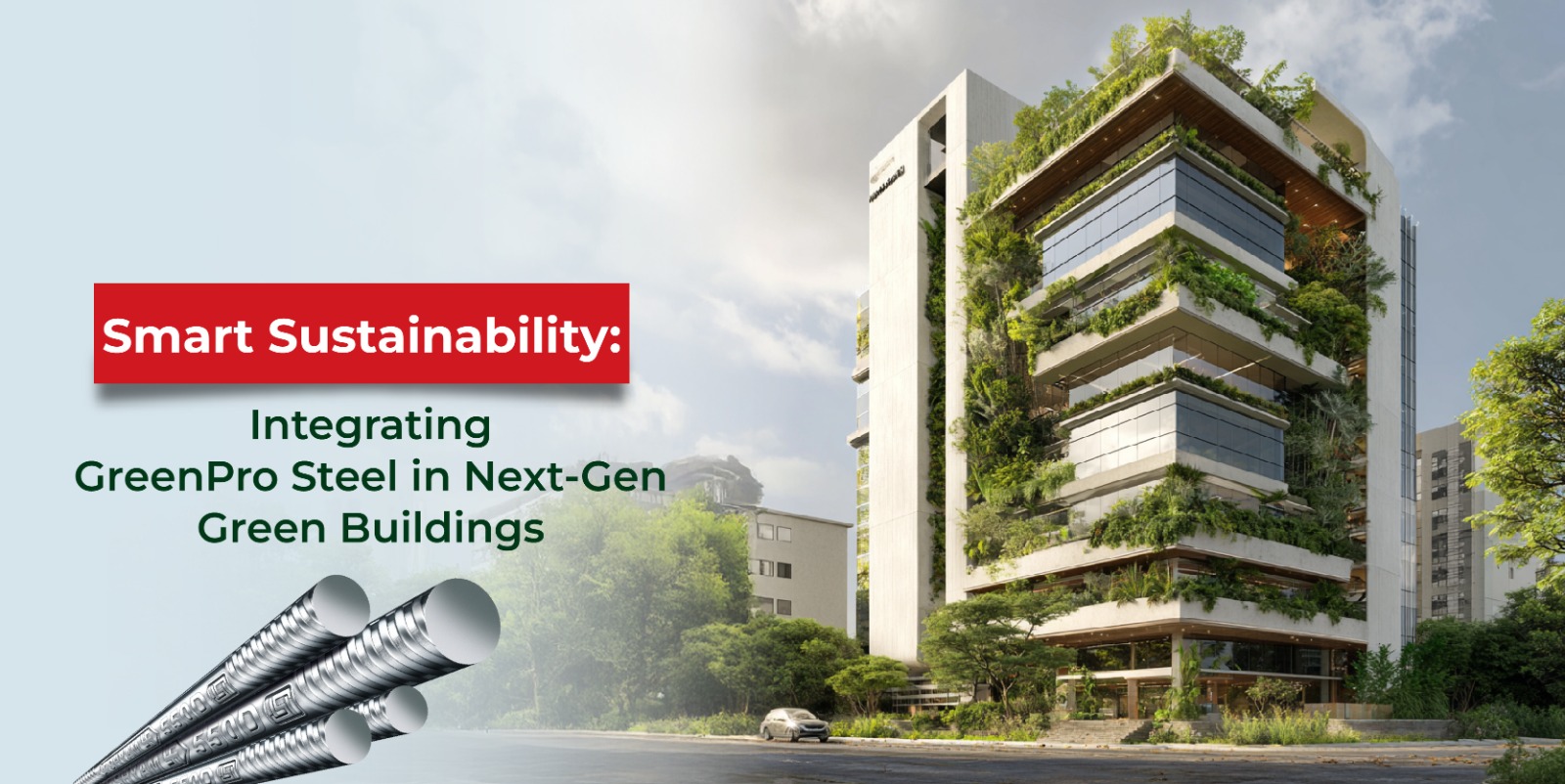
Smart Sustainability: Integrating GreenPro Steel in Next-Gen Green Buildings
You’re sitting in a project review meeting. The developer wants IGBC Gold. The architect has specified a structural system. The procurement team is asking why they should pay attention to the sustainability documentation on the rebar. Sound familiar?
Here’s the short answer: because material choices – starting with structural steel – now directly determine whether your project earns green building certification credits, qualifies for government procurement, and attracts the investors who care about ESG.
India’s green building market stood at USD 37.99 billion in FY2024 and is projected to reach USD 85 billion by FY2032 – growing at a 10.59% CAGR (Markets and Data, 2025). Meanwhile, India is leading the Asia-Pacific region in green building adoption with the fastest growth rate of 13.02% CAGR through 2030. This isn’t a niche trend. It is the direction the entire construction industry is moving.
And at the centre of this shift is a question that every architect, developer, and EPC contractor needs to answer: are the materials I’m specifying – especially the structural steel – certified green?
In this post, we break down how GreenPro-certified TMT rebars fit into India’s major green building rating frameworks, what the certification actually means, and why it matters for your next project – whether it’s a housing complex in Patna, a commercial tower in Bhubaneswar, or a government facility anywhere across Rest of India.
1. Why Structural Steel Is at the Centre of the Green Building Conversation
When most people think about green buildings, they think about solar panels, rainwater harvesting systems, and LED lighting. These are visible, easy to communicate. But buildings already contribute to about 25% of India’s total greenhouse gas emissions, and steel alone accounts for approximately 12% of those building-related emissions (IBEF, January 2026).
This is why embodied carbon – the carbon emitted during the production and transportation of building materials, before a building is even occupied – has become a critical sustainability metric. Structural steel, as the backbone of any RCC-framed building, carries significant embodied carbon weight.
The good news? Steel is also one of the most recyclable materials on the planet. Unlike plastic (which degrades with recycling) or concrete (which is notoriously difficult to recycle), steel can be recycled indefinitely without loss of structural properties. That circularity is precisely why recycled-content, green-certified steel is gaining traction in India’s sustainability frameworks.
India’s Extended Producer Responsibility (EPR) regulations will require secondary materials usage in major projects starting at 5% in 2026–27, rising to 25% by 2030. Green-certified recycled steel is directly positioned to meet these mandates.
For construction professionals, this means that specifying GreenPro-certified TMT rebars is not just a sustainability gesture – it is forward-looking procurement that keeps your projects ahead of tightening regulatory requirements.
2. Understanding GreenPro Certification: What It Actually Evaluates
GreenPro is India’s national green product certification, developed and administered by the Confederation of Indian Industry (CII) through its Green Products and Services Council. It is the only product-level green certification in India backed by CII-IGBC, which makes it directly aligned with the IGBC green building rating system.
The certification evaluates products through a full lifecycle lens. This includes:
- Raw material sourcing: Origin, recycled content percentage, and responsible extraction
- Manufacturing process: Energy consumption, water use, emissions, and waste generated during production
- Product performance: Structural strength, durability, and compliance with Indian standards (BIS, RDSO)
- Recyclability and end-of-life: How the product can be recovered, reused, or recycled after demolition
- Health and indoor environment: Absence of harmful substances that could affect occupant or worker health
A product earns GreenPro certification only after it achieves the required credit points across all evaluation categories. This is a rigorous assessment – not a self-declaration.
Shyam Steel’s GreenPro Credentials
Shyam Steel’s TMT rebars have earned GreenPro certification from CII’s Green Products and Services Council for both Fe 500D (cert no. GPSSM345002) and Fe 550D (cert no. GPSSM345001), manufactured at the Angadpur and Mejia plants in West Bengal respectively. Both grades achieved all required credit points across GreenPro’s evaluation framework – a testament to the manufacturing standards and sustainability practices embedded in production.
As Lalit Beriwala, Director of Shyam Steel Industries, has stated: the trajectory toward green steel is not a question of if, but when – and Shyam Steel’s GreenPro certification positions both the company and its customers on the right side of that transition.
3. How GreenPro Steel Helps You Earn Points Across India’s Three Major Rating Systems
India’s green building ecosystem runs on three primary certification frameworks: IGBC (Indian Green Building Council), GRIHA (Green Rating for Integrated Habitat Assessment), and LEED (as administered in India through IGBC). Each has its own credit structure, but all three award points for sustainable material choices – and GreenPro-certified steel is specifically recognised within these frameworks.
IGBC: India’s Most Widely Used Green Building Rating
IGBC currently has over 8,669 projects registered with a combined footprint of 9.75 billion square feet – making it the dominant green building certification in India. IGBC’s rating systems cover residential, commercial, industrial, healthcare, mass transit, and township typologies.
Under IGBC’s materials credits, projects earn points for using regionally manufactured materials, materials with recycled content, and materials certified under recognised green product schemes – of which GreenPro is the primary India-specific certification. Using GreenPro-certified TMT rebars contributes directly to the Materials and Resources category of your IGBC scorecard.
Important update: IGBC has transitioned its Green New Buildings Rating System from Version 3 to Version 4 (NB_v4.0), effective 1 May 2026. Projects should register under the new version and confirm how material credits are structured under NB_v4.0 to ensure GreenPro credits are maximally applied.
GRIHA: India’s National Rating for Government and Institutional Buildings
GRIHA is India’s homegrown rating system, developed by TERI and adopted by the Ministry of New and Renewable Energy. The Indian government has mandated GRIHA certification for all new central government building projects – making it the de facto standard for public-sector construction across India.
GRIHA certifications have helped reduce embodied energy in building materials by up to 30% in certified projects. For government infrastructure projects across Bihar, Odisha, and the Northeast, where GRIHA certification is either mandated or incentivised through state policies, specifying GreenPro-certified TMT rebars provides documented evidence of sustainable material procurement – a required element of the GRIHA audit trail.
State governments are increasingly adding financial incentives for GRIHA-rated buildings. Assam’s green building policy, for instance, offers additional FAR for Silver, Gold, and Platinum-rated projects. Odisha and Bihar are expected to follow suit as national green building mandates filter into state-level policy.
LEED: For Projects Targeting International Tenants and Investors
LEED, as administered in India through IGBC, is the preferred certification for commercial real estate targeting multinational tenants and ESG-sensitive institutional investors. LEED credits for Materials and Resources – including points for recycled content, regional materials, and certified sustainable products – are directly served by GreenPro-certified steel procurement.
For developers building commercial or mixed-use projects in Tier-2 cities across Rest of India, LEED certification with GreenPro-documented steel procurement makes a strong case to investors and lenders who require sustainability performance reporting.
4. The Business Case for GreenPro Steel: Beyond the Certificate
Let’s move past the idealism for a moment. Green building certification is increasingly a commercial necessity – not just an environmental aspiration. Here is the practical business case for specifying GreenPro-certified TMT rebars:
Government Procurement Preference
India’s central government is actively exploring a green steel procurement mandate that would require a specified percentage of green steel in state-funded projects (Sustainable Construction Materials Report, December 2024). Developers and EPC contractors who have GreenPro documentation in place today are positioned to qualify for these mandates when they come into effect – ahead of competitors who don’t.
Green Finance and Bond Access
The Reserve Bank of India’s green bond pilots offer interest-rate concessions for projects demonstrating sustainable construction practices. SEBI rules now require developers to report the sustainability performance of material vendors. GreenPro certification on your rebar procurement directly supports this supply-chain sustainability disclosure – an increasingly standard requirement for accessing green finance instruments.
Faster Project Approvals and Additional FAR
Several states already offer tangible planning benefits for certified green projects. Certified green projects can access up to a 25% capital subsidy in certain states, while state governments including Andhra Pradesh, Tamil Nadu, and Telangana provide 5 to 20% property tax rebates for buildings using sustainable materials. Assam’s green building policy offers 3% to 9% additional FAR (Floor Area Ratio) for Silver through Platinum-rated projects – directly increasing the developable value of a site.
Investor and Occupier Demand
India’s green building market grew at 12.3% in 2024. The residential segment alone was valued at USD 25.9 billion, representing 72% of the total market (GlobalData, 2024). Green-certified buildings attract environmentally conscious investors and consistently command higher resale values and lower vacancy rates. In a competitive real estate market, IGBC or GRIHA certification – enabled in part by GreenPro-certified structural steel – is a meaningful differentiator.
5. Integrating GreenPro Steel into Your Project Workflow: A Practical Guide
Understanding why GreenPro steel matters is one thing. Knowing how to actually integrate it into your procurement and certification workflow is another. Here is a step-by-step approach for construction professionals in Bihar, Odisha, Jharkhand, and the Northeast:
Step 1 – Decide Your Target Rating at Project Inception
The choice of IGBC, GRIHA, or LEED shapes your entire material specification strategy. Government projects should default to GRIHA. Commercial projects targeting international tenants should consider LEED. Mixed-use and residential developments in Tier-2 cities will typically find IGBC the most pragmatic path. Make this decision at the design stage – retrofitting sustainability documentation after procurement is costly and often incomplete.
Step 2 – Specify GreenPro-Certified Steel by Name and Cert Number
In your bill of quantities and procurement specification, explicitly list the required GreenPro certification number alongside the grade (Fe 500D / Fe 550D) and BIS standard. This prevents substitution with non-certified alternatives during procurement. Verification: cert numbers can be confirmed directly through the CII–Green Products and Services Council’s GreenPro registry.
Step 3 – Collect and Retain All Certification Documentation
Green building auditors will require proof of sustainable material use. Retain:
- GreenPro certification certificate (name, cert number, validity period)
- Mill Test Certificate (MTC) from the same batch as delivered material
- Purchase invoices and delivery challans linking the certified product to your project
- Manufacturer’s declaration of recycled content percentage
Step 4 – Map Each Steel Consignment to Rating Credits
Work with your green building consultant to map each certified material consignment to specific credits in your rating framework. Under IGBC and GRIHA, this documentation directly feeds into the Materials and Resources credit category. Maintaining a running credit tracker from the procurement stage – not retrospectively – dramatically simplifies the final certification audit.
Step 5 – Engage Your Supply Chain Early for Regional Logistics
For projects in Bihar, Jharkhand, Odisha, and the Northeast, confirm that your certified rebar supplier has a reliable dealer and logistics network in your district. Regional supply consistency is essential – gaps in rebar delivery create project delays that no certification shortcut can fix. Verify lead times and dealer proximity at the project planning stage, not during construction.
6. The Circular Economy Advantage of GreenPro-Certified Rebars
One of GreenPro’s most powerful evaluation criteria – and one of steel’s most compelling environmental advantages – is its circular economy compatibility.
Steel produced with a high recycled content percentage uses significantly less energy and generates substantially lower carbon emissions than steel produced entirely from virgin iron ore. When buildings using GreenPro-certified rebars are eventually demolished, the steel inside flows directly back into production cycles without any loss of structural integrity – an infinite loop of material value.
India generates an estimated 150 to 500 million tonnes of construction and demolition waste annually, with less than 1% currently recycled. As EPR regulations tighten and carbon accounting becomes standard practice, the circular economy credentials of GreenPro-certified steel will become an even stronger procurement argument – for developers, institutional investors, and government agencies alike.
Sustainable structural products – including recycled and green-certified steel – hold the largest share (~40%) of India’s green building materials market in 2025. This is the fastest-growing procurement category for certified construction.
7. The Numbers That Define India’s Green Building Opportunity
For project managers and developers evaluating the investment case, here is the market context in plain numbers:
- USD 85 billion: Projected size of India’s green building market by FY2032 (CAGR: 10.59%)
- USD 32.2 billion: India’s green building materials market by 2032, up from USD 15.5 billion in 2025 (CAGR: 11.3%)
- 13.02% CAGR: India’s green building adoption rate – fastest in the Asia-Pacific region (Mordor Intelligence, 2025)
- 8,669 projects: Currently registered with IGBC across India, covering 9.75 billion square feet
- 70%: Share of India’s 2030 urban infrastructure that is yet to be built – the opportunity window for green specifications is open right now
The scale of what India is building – and the scale of the sustainability standards it will be built to – makes GreenPro-certified structural steel not a premium choice, but a baseline specification for any serious construction professional.
Building Green Starts with What’s Inside the Concrete
The most visible elements of a green building – the rooftop solar, the water recycling system, the smart HVAC – are important. But they sit on a structure. And that structure is reinforced concrete. And that concrete is only as sustainable as the steel inside it.
When you specify GreenPro-certified TMT rebars, you are making a decision that flows through the entire life of a building: from procurement documentation to IGBC credit scores, from GRIHA audit trails to green bond qualification, from resale value to the circular economy when the building is eventually demolished and its steel is recovered and reused.
Smart sustainability isn’t about adding green features on top of conventional construction. It is about making sustainable decisions from the foundation up – literally.
At Shyam Steel, our GreenPro-certified Fe 500D and Fe 550D TMT rebars are built to help your projects achieve exactly that – from the ground up, with documentation that holds up to every green building auditor’s scrutiny.