Low Carbon Steel: Why It Builds Better TMT Rods
Ask a site engineer what actually worries them about reinforcement steel, and carbon content rarely comes up first. People usually worry about the cost and the delivery timelines. Yet carbon percentage is the one facet that quietly decides how a 550D TMT bar bends, welds, and survives the next twenty years buried in concrete.Getting it wrong can mean that even a bar with impressive yield strength on paper may crack at the weld joint. Or corrode faster than expected.
This is where low carbon steel changes the equation for TMT (Thermo-Mechanically Treated) reinforcement bars, and why a grade like the Shyam Steel 550D TMT bar is built around keeping that number down rather than chasing strength at any cost.
What Low Carbon Actually Means for a TMT Bar
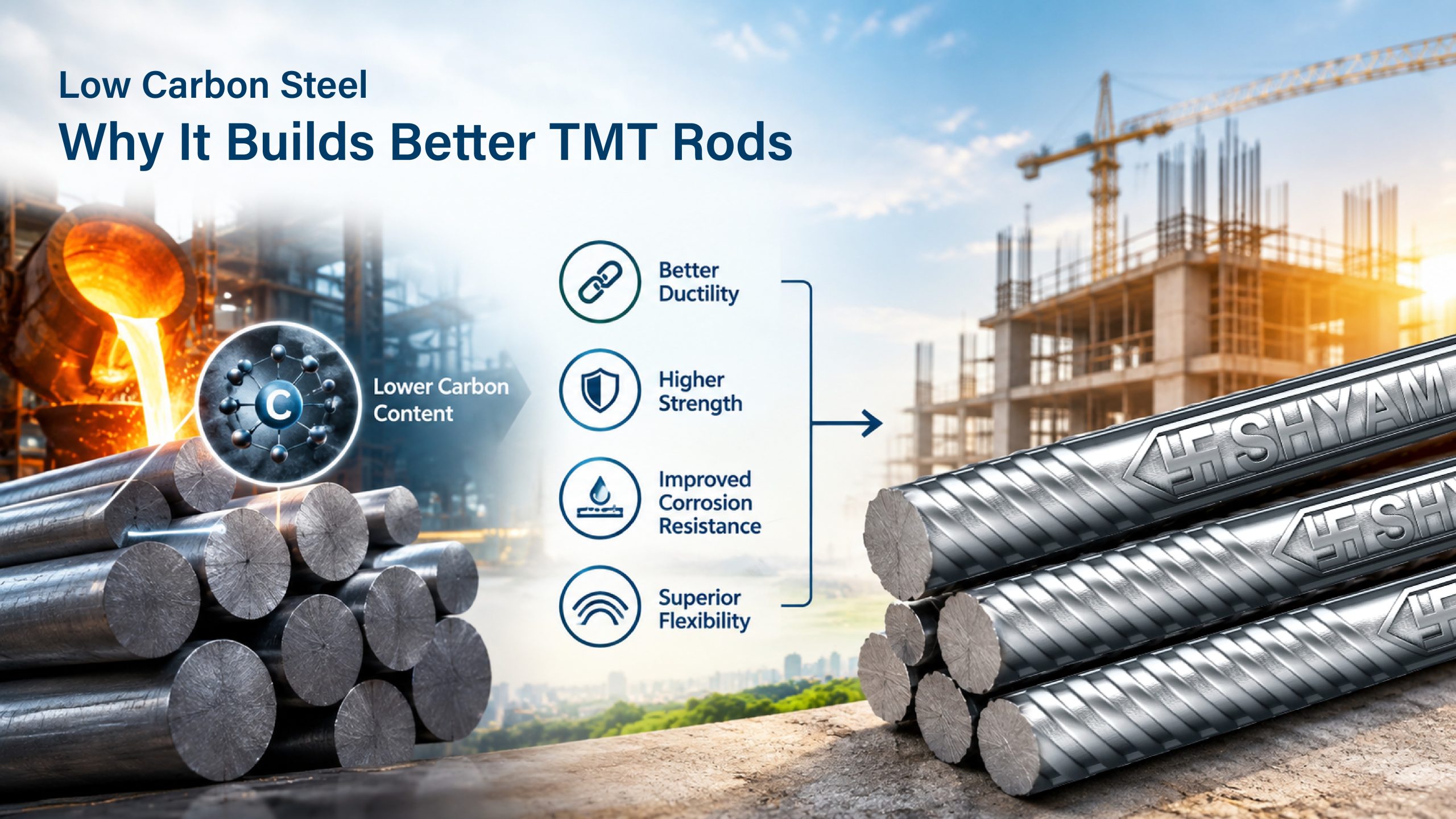
Carbon gives steel its strength, but past a certain point it also makes the bar brittle and harder to work with on the construction site. Fe 500D and Fe 550D grades are rated for high yield strength, so the real manufacturing challenge is holding that strength while keeping carbon content low enough that the bar stays ductile and weldable.
A Shyam Steel TMT bar is manufactured with exactly this trade-off in mind. Carbon content in its 550D TMT bar grade tops out around 0.20%, against the 0.25% ceiling permitted under IS 1786:2008. That half a percentage point matters more on a construction site than it looks like on a spec sheet.
Why Weldability Depends on Carbon
Without any pre-heat or post-weld treatment, a high-carbon steel bar becomes so brittle that it may develop cracks under load. This is one of the most frequently occurring failure modes at construction sites with respect to reinforcement steel, and it occurs mostly after the construction process is completed.
This problem is solved by having low carbon content in the material itself rather than dealing with it during the construction phase. With the use of proper thermo-mechanical treatment in the process of rolling, there is no requirement for pre- or post-weld heat treatment for a Shyam Steel TMT bar.
Corrosion Resistance Built Into the Rim
The thermo-mechanical process does more than regulate the hardness; it creates a rim of tempered martensite surrounding a softer core that is virtually free of stress and offers more resistance to corrosion and fatigue compared to the surface of a rolled bar.
It becomes critical in cases where the bar would be used in coastal construction, basements, and structures that come into contact with moisture over long periods of time, years rather than months.
Fe 550D: Strength Without Giving Up Ductility
Here’s where the low-carbon approach shows up in the numbers. Against the IS 1786:2008 minimums for Fe 550D, a 550 MPa yield stress, 600 MPa tensile strength, and 14.5% elongation, the 550D TMT bar from Shyam Steel is built to run higher on every count: yield stress around 580 MPa, tensile strength around 680 MPa, and elongation near 20%. Combined sulphur and phosphorus content, the two elements most responsible for brittleness, sits around 0.058%, well under the IS ceiling of 0.075%.
That gap isn’t just for compliance paperwork. Higher elongation means the bar bends further before it fails, which is exactly what seismic design codes like IS 13920:2016 (Amendment 2) demand from reinforcement steel in earthquake-prone zones.
What Backs the Manufacturing Process
Nothing of this nature is achieved by chance in the production process on the factory floor. Shyam Steel maintains an integrated plant in Durgapur in which its DRI Plant, SMS Plant (Electric Arc Furnace), Continuous Billet Casting Plant, and Rolling Mill are all housed under one roof, together with its own laboratory facilities to test the batches for compliance with the IS 1786:2008 standard before shipment.
This integration of controlled carbon content, in-house testing, and third-party certification is what differentiates a best-quality TMT bar from one that just makes the cut based on the datasheet.
Finding the Best Steel Rod in India for Your Project
A reinforcement bar does not make any promises regarding a shortcut in manufacturing when you buy it. Instead, you start facing challenges after some years, in the form of a crack at the weld or rust seeping through the plastered wall. This is why low-carbon TMT bars from a producer that maintains equally tight control over the chemical composition of its product should be considered.
When engineers and contractors choose the best bar among several options, a TMT bar from Shyam Steel is a strong place to start their search for the best steel rod in India, because it provides documentation on chemistry and IS-compliant mechanical properties.
FAQs
Q. Does Low Carbon Steel Mean Lower Strength in a 550D TMT Bar?
Not really. The thermo-mechanical process compensates for lower carbon by forming a hardened outer rim during controlled cooling, so a 550D TMT bar still reaches yield strengths above 550 MPa despite carbon content under 0.25%.
Q. Why Does Shyam Steel Keep Carbon Content Below The Is Limit?
Lower carbon, around 0.20% in the Shyam Steel TMT bar Fe 550D grade, improves weldability and ductility without sacrificing the yield strength required under IS 1786:2008.
Q. What Makes A Tmt Bar The Best Quality Tmt Bar For Coastal Or Humid Regions?
Look for a documented corrosion-resistant rim, IS 1786:2008 compliance, and third-party lab testing. All three are part of what qualifies Shyam Steel’s range as a best-quality TMT bar for such conditions, backed by ISO 9001, ISO 14001, and OHSAS 18001 certification.
Q. What Should I Check Before Picking The Best Steel Rod In India For A Project?
Compare carbon content, IS 1786:2008 compliance, yield and tensile strength margins over the minimum, and whether the manufacturer runs in-house testing labs. On the best steel rod in India shortlist, a documented chemistry sheet counts for more than a brand name alone.