
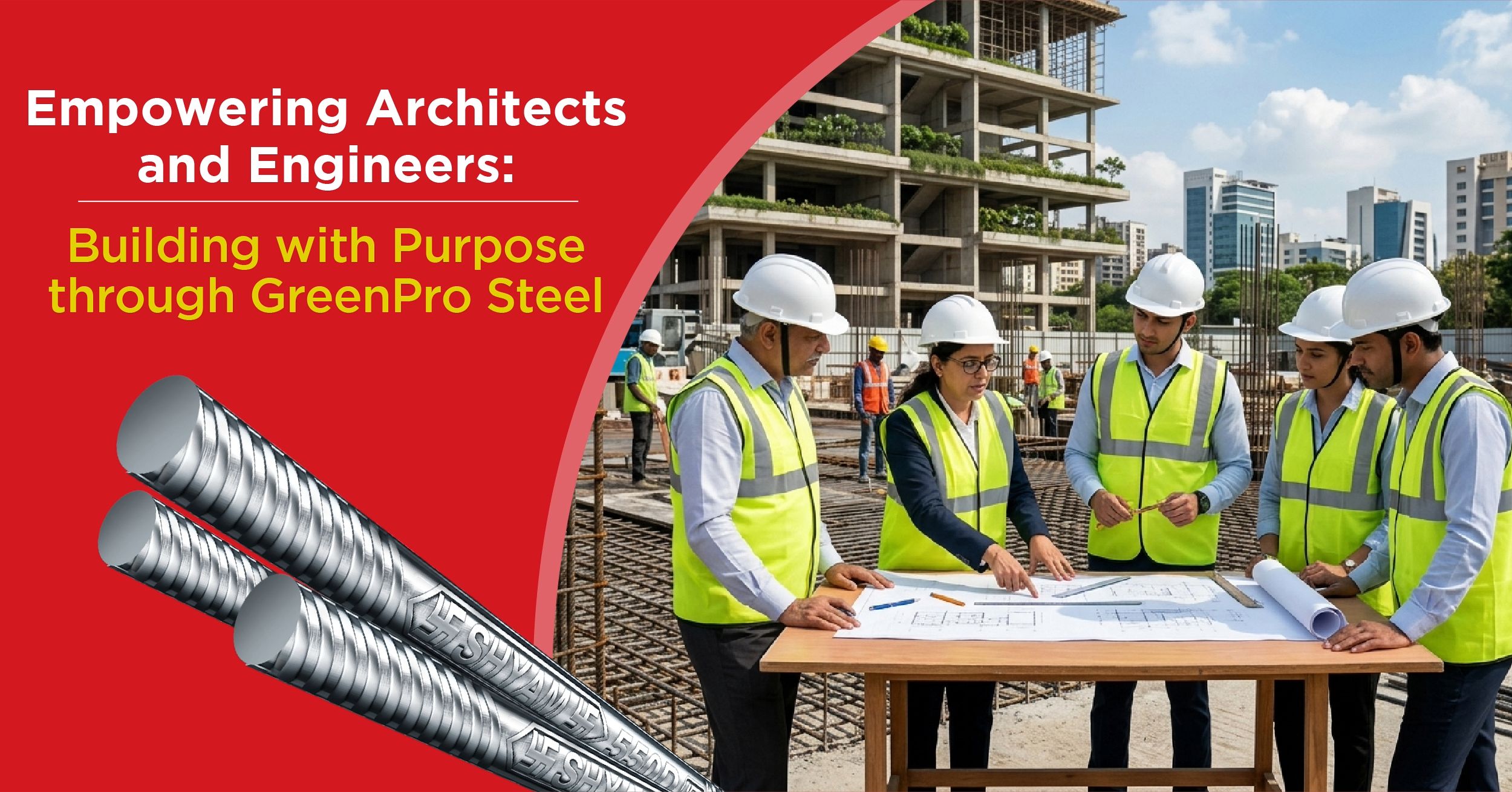
Empowering Architects and Engineers: Building with Purpose through GreenPro Steel
Every building begins as a decision, a decision about materials, methods, and the mark a structure will leave on the world long after it’s built. For today’s architects and engineers, that decision increasingly comes down to one question: how do you build strong, safe, and lasting structures without compromising the planet they stand on? GreenPro Steel from Shyam Steel offers a compelling answer, and it’s changing the way professionals across India think about sustainable construction.
What is GreenPro Steel?
GreenPro certification is awarded by the Confederation of Indian Industry’s (CII) Green Products and Services Council, and it is far from a rubber stamp. A product earns this certification only after it clears a rigorous, multi-category evaluation covering raw material sourcing, manufacturing efficiency, energy consumption, and end-of-life recyclability. Shyam Steel’s TMT rebars, both Fe 500D and Fe 550D grades, have earned this certification, produced respectively at the company’s Angadpur and Mejia plants in West Bengal.
In practical terms, this means every rebar carrying the GreenPro mark has been independently verified as meeting stringent sustainability benchmarks, not merely self-declared as “eco-friendly.” For architects and engineers who are ultimately accountable for the materials they specify, that independent verification carries real weight, especially when a project’s green credentials are being audited.
Why This Matters to Architects and Engineers
1. Green Building Certifications Depend on Material Choices
If you’re working on a project targeting IGBC or GRIHA ratings, or pursuing green bond financing, the materials you specify directly affect your credit scores. GreenPro-certified rebar isn’t just a “nice to have” line item, it can be the difference between a project qualifying for green incentives and falling short. Specifying GreenPro Steel gives design teams documentation that holds up under scrutiny, from procurement records to final certification audits.
2. Strength Doesn’t Take a Back Seat to Sustainability
A common misconception is that sustainable materials mean a trade-off in performance. That’s not the case here. Fe 550D TMT rebars are engineered to comply with seismic safety standards under IS 13920:2016 (Amendment 2), making them suitable for structures in high-risk seismic zones. Fe 500D, meanwhile, is built for heavy-load RCC applications, flyovers, bridges, dams, and other critical infrastructure, where high yield strength cannot be compromised. Both grades deliver the ductility, corrosion resistance, and load-bearing capacity that structural engineers depend on, while meeting a sustainability standard most conventional rebar simply doesn’t attempt.
3. Lower Carbon Footprint Without Redesigning Your Workflow
Shyam Steel’s manufacturing process incorporates recycled materials and controlled thermomechanical treatment, which reduces the embodied carbon of every rebar produced. For engineers under increasing pressure to report a project’s carbon footprint, specifying GreenPro Steel is one of the most direct levers available, it reduces emissions at the material level, before a single beam is poured or a column is cast.
4. A Material That Supports the Full Building Lifecycle
Sustainability isn’t only about how a material is made, it’s also about what happens when a building’s life ends. GreenPro Steel supports the circular economy: at demolition, the steel can be recovered and reused, rather than becoming landfill waste. For architects designing with a long-term view, thinking not just about occupancy but about a structure’s eventual deconstruction, this closes an important loop that conventional materials often leave open.
Practical Applications for Design Professionals
Architects and structural engineers working across residential, commercial, and infrastructure projects will find GreenPro Steel adaptable to a wide range of applications:
- High-rise and skyscraper construction, where strength-to-weight ratio and ductility are critical to withstanding seismic and wind loads.
- Bridges, flyovers, and dams, where Fe 500D’s heavy-load capacity is essential.
- Green-certified residential and commercial developments, where GreenPro documentation directly supports IGBC or GRIHA credit points.
- Coastal and high-humidity regions, where the corrosion-resistant martensitic rim developed through controlled thermomechanical treatment extends structural lifespan significantly.
Because Shyam Steel’s TMT rebars come in consistent grades, dimensions, and tolerances, engineers can also specify with confidence across large, multi-phase projects without worrying about batch-to-batch variability, a detail that matters as much for structural integrity as it does for sustainability reporting.
Making the Case to Clients and Stakeholders
One of the quieter benefits of specifying GreenPro Steel is how it strengthens the conversation with clients and stakeholders. Sustainability is no longer a differentiator reserved for flagship green buildings, it’s becoming a baseline expectation, especially for institutional and government-funded projects. Architects who can point to independently certified materials, backed by documented credit points across CII’s evaluation framework, are better positioned to win approvals, satisfy ESG-conscious investors, and future-proof their designs against tightening environmental regulations.
Building with Purpose
The shift toward greener construction isn’t a distant trend, it’s already reshaping specifications, tenders, and design briefs across India. For architects and engineers who want their structural choices to reflect both technical rigor and environmental responsibility, GreenPro Steel offers a rare combination: certified sustainability credentials paired with the strength, ductility, and seismic performance that critical structures demand.
Choosing GreenPro Steel isn’t about ticking a sustainability checkbox, it’s about building structures that are ready for the next fifty years, not just the next inspection. As green building standards continue to tighten, the professionals who specify with foresight today will be the ones setting the benchmark tomorrow.
Ready to specify GreenPro-certified TMT rebars for your next project? Contact Shyam Steel to plan your project costs.