
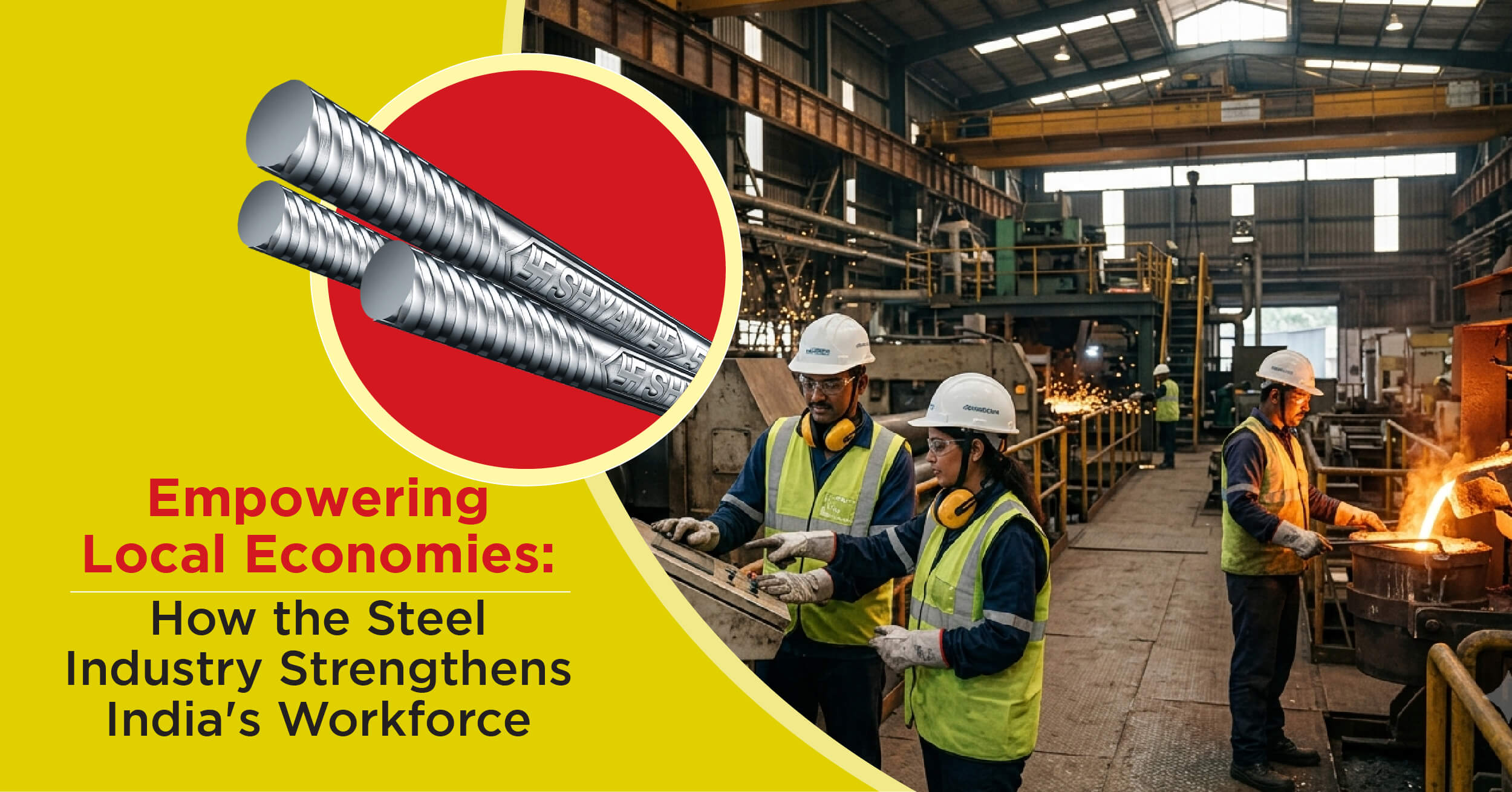
Empowering Local Economies: How the Steel Industry Strengthens India’s Workforce
Introduction
Steel is often called the backbone of modern civilisation, and in India, that description holds truer than ever. From towering skyscrapers and sprawling highways to the humble reinforcement rebars that hold up a family home, steel touches nearly every corner of daily life. But beyond bridges and buildings, the steel industry plays a role that is far less visible yet equally powerful, it strengthens India’s workforce and, in turn, its local economies.
As India marches toward its vision of becoming a $5 trillion economy, the steel sector stands as one of its most reliable engines of employment, skill development, and regional prosperity. In this blog, we explore how the steel industry is empowering local economies across the country, one job, one plant, and one community at a time.
The Steel Industry: A Pillar of India’s Economic Growth
India is the world’s second-largest crude steel producer, and the industry contributes close to 2% of the country’s GDP. But numbers on a balance sheet only tell half the story. Behind every tonne of steel produced lies a vast ecosystem of mines, plants, logistics networks, ancillary units, and thousands of families whose livelihoods depend on this sector.
The steel industry currently provides direct employment to roughly six lakh people in India, with an additional twenty lakh people employed indirectly through allied industries such as transportation, packaging, fabrication, and retail distribution. This dual impact, direct and indirect, is what makes steel manufacturing such a powerful catalyst for local economic development, especially in regions rich in iron ore and mineral resources like Odisha, Jharkhand, Chhattisgarh, and West Bengal.
Creating Jobs at Every Skill Level
One of the most remarkable aspects of the steel industry is its ability to generate employment across the entire skill spectrum. It’s not just about engineers and metallurgists; it’s about welders, machine operators, quality inspectors, logistics staff, electricians, and daily-wage labourers who all find stable, long-term work within this sector.
For many first-generation workers migrating from rural areas, a job in a steel plant is often their first step into formal employment. It comes with structured wages, safety training, and opportunities for growth, a stark contrast to the uncertainty of seasonal agricultural work. This creates a ripple effect: as workers earn steady incomes, they spend locally, support their families’ education, and contribute to the overall economic vitality of their towns and villages.
Government Initiatives Fuelling Employment Growth
The Indian government has recognised the employment potential of the steel sector and has backed it with targeted policy support. The Production Linked Incentive (PLI) Scheme for Specialty Steel, for instance, has already generated thousands of direct jobs while attracting significant investment into advanced steel manufacturing. Newer rounds of the scheme continue to prioritise employment generation alongside capacity expansion, particularly in emerging and value-added steel products.
Alongside this, the government’s push for a “Just Transition”, upskilling and reskilling the steel workforce for a low-carbon future, signals a long-term commitment to keeping the sector’s workforce relevant as the industry moves toward greener, more sustainable production methods. For workers, this means access to training in modern, in-demand technical skills rather than being left behind by industry change.
Skill Development and Vocational Training
The steel industry doesn’t just create jobs; it actively invests in building the capabilities of its workforce. Many steel manufacturers, including established players in the eastern belt of India, run vocational training centres, apprenticeship programmes, and on-the-job skilling initiatives in partnership with local Industrial Training Institutes (ITIs) and government skilling missions.
This focus on skill development is crucial. As the industry adopts automation, energy-efficient furnaces, and greener manufacturing processes, workers need continuous upskilling to stay employable. Companies that invest in their people are not just building a more capable workforce, they are building loyalty, reducing attrition, and creating a multiplier effect where trained workers pass their skills on to the next generation in their communities.
Strengthening Ancillary and MSME Ecosystems
A single steel plant rarely operates in isolation. It relies on a web of ancillary businesses, from small-scale fabrication units and transport contractors to scrap dealers and packaging suppliers. Secondary and MSME steel producers alone account for nearly half of India’s crude steel capacity, underlining just how deeply the sector is intertwined with small and medium enterprises.
This interdependence means that every large steel manufacturing hub becomes a nucleus for dozens of smaller businesses, each providing additional local employment. Truck drivers ferrying raw materials, small workshops fabricating steel products for construction, and local vendors supplying goods to plant workers, all of them form an extended economic community that thrives because of the steel industry’s presence.
Building Resilient Local Economies
Perhaps the most understated impact of the steel industry is regional resilience. In many parts of India, particularly in mineral-rich but otherwise underdeveloped states, a steel plant can be the single largest formal employer in the district. This has a stabilising effect, it reduces distress migration to cities, supports local infrastructure development (roads, schools, healthcare facilities often follow industrial investment), and creates a tax base that funds public services.
As steel companies expand capacity and invest in new, sustainable production facilities, they bring fresh waves of employment and infrastructure development to these regions, reinforcing a cycle of growth that benefits generations of local families.
Conclusion
The steel industry’s contribution to India goes far beyond the tonnes of metal it produces each year. It is a powerful engine of employment, skill-building, and local economic empowerment, touching millions of lives directly and indirectly. As India continues to invest in green steel technologies, capacity expansion, and workforce upskilling, the sector is poised to remain one of the strongest pillars supporting the country’s workforce and local economies for decades to come. At Shyam Steel, we recognise that our strength lies not just in the steel we manufacture, but in the people and communities we empower along the way. To learn more about our commitment to quality and community-driven growth, explore our about us page.