
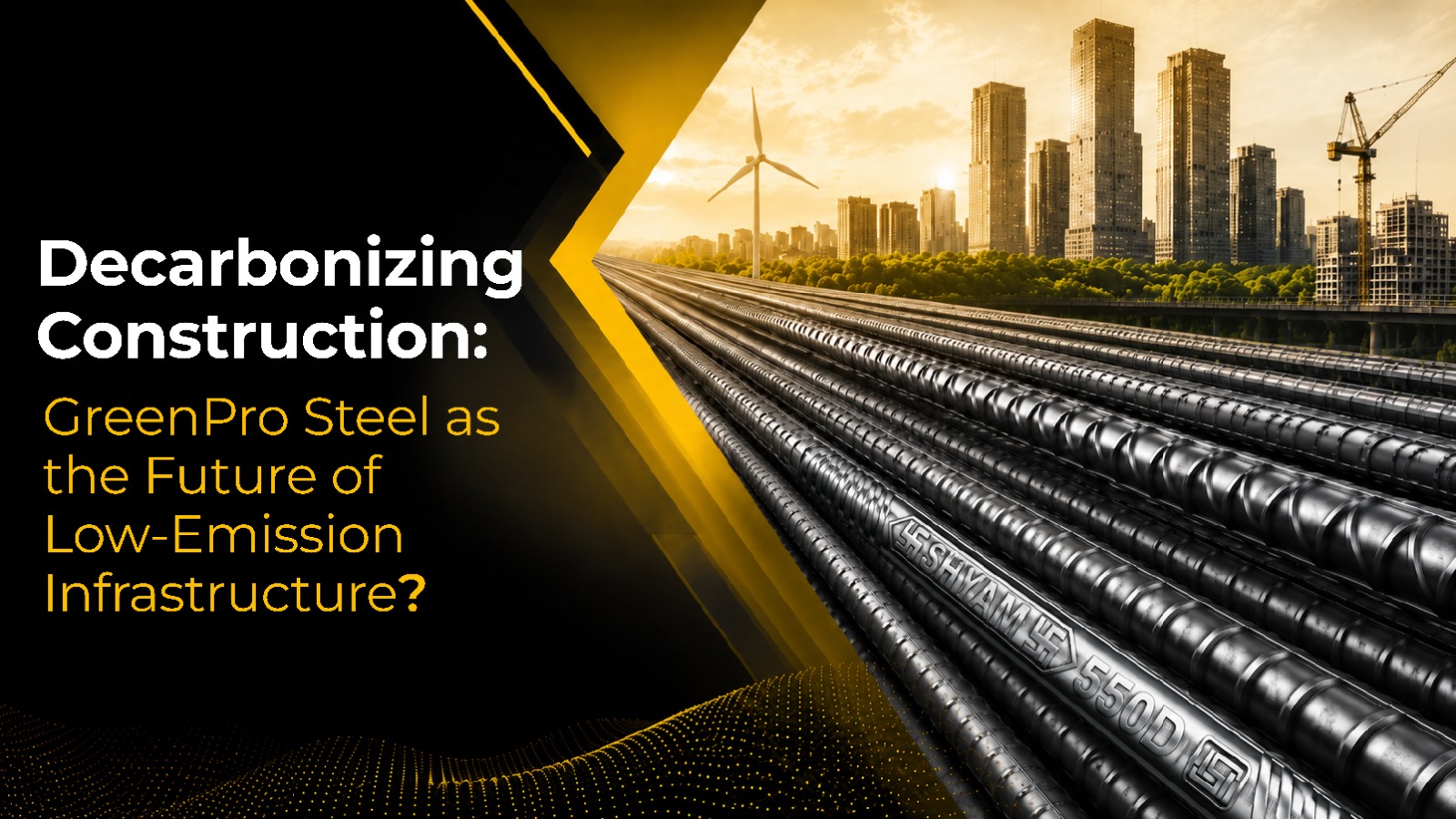
Decarbonizing Construction: GreenPro Steel as the Future of Low-Emission Infrastructure
Introduction: The Carbon Question Construction Cannot Avoid
There is a number that every construction professional in India needs to know: 10 to 12.
That is the percentage of India’s total carbon emissions that come from the steel sector alone. It is one of the highest industrial contributions in the country — and it sits at the foundation, quite literally, of every structure we build. The concrete we pour, the frames we erect, the floors we cast — all of them are reinforced by steel, and all of them carry an embodied carbon footprint that is increasingly difficult to ignore.
India is now the world’s second-largest steel producer, with capacity projected to reach 300 million tonnes by 2030. The country leads the world in new steel plant construction, accounting for 40% of global planned capacity. That is not just a production story. It is a climate story — and one where every specification decision made on every construction project in Bihar, Odisha, or Jharkhand has a meaningful role to play.
At Shyam Steel, we believe civil engineers and architects should not have to choose between structural performance and environmental responsibility. With our GreenPro-certified TMT rebars, they do not have to.
Why the Construction Sector Must Act Now
India’s steel decarbonisation challenge is real and well-documented. A 2026 assessment of Indian steel producers by the Institute for Energy Economics and Financial Analysis (IEEFA) found that emissions intensity has actually worsened over the past three years for most Indian producers, even as climate commitments have become more ambitious. The gap between stated targets and operational change is widening.
This matters for construction professionals for a specific reason: the embodied carbon of a building — the emissions locked into its materials at the point of manufacture — is increasingly subject to regulatory scrutiny, institutional procurement requirements, and ESG reporting mandates. Projects that do not account for material-level carbon credentials today will face compliance gaps in the years ahead.
The regulatory landscape is already shifting:
- India’s Carbon Credit Trading Scheme (CCTS) is expanding its scope to include steel-sector intensity targets.
- The EU’s Carbon Border Adjustment Mechanism (CBAM), fully implemented from January 2026, imposes carbon costs on high-emission steel — a signal of the direction global standards are headed.
- India’s Smart Cities Mission and public-sector infrastructure procurement are increasingly prioritising materials with verifiable environmental credentials.
- IGBC currently has 8,669 projects registered across India covering 9.75 billion square feet — all of which require certified sustainable materials to achieve their green building ratings.
For engineers specifying TMT rebars in East India, this is not a distant regulatory concern. It is the current procurement environment.
What Makes GreenPro Steel the Answer for Low-Emission Infrastructure
GreenPro certification, issued by the CII–Green Products and Services Council, is India’s benchmark ecolabel for construction materials. It evaluates products across their full lifecycle — from raw material extraction and energy consumption during manufacturing, through to recyclability and end-of-life environmental impact.
Shyam Steel’s GreenPro-certified TMT rebars meet this standard in ways that translate directly into value for infrastructure projects:
Embodied Carbon Reduction
One of the most immediate ways to reduce a project’s carbon footprint is to specify materials with lower embodied carbon. Shyam Steel’s manufacturing processes are optimised to minimise energy intensity and emissions at every stage of production. Our GreenPro certification provides the verified documentation that engineers and project developers need to substantiate their embodied carbon calculations — whether for GRIHA submissions, IGBC assessments, or ESG reporting to institutional financiers.
Circular Economy Credentials
Steel’s circularity is one of its most underutilised sustainability advantages. Unlike concrete or composite materials, steel can be recovered and recycled at end-of-life without degradation — returning its full structural value to the material economy. This is precisely why steel holds the largest share (approximately 40%) of India’s green building materials market in 2025, according to market analysis.
When you specify GreenPro-certified TMT rebars from Shyam Steel, you are specifying a material with documented recyclability credentials — credentials that support circular economy reporting and align with India’s EPR mandate trajectory.
Seismic and Structural Performance Without Compromise
Decarbonization does not mean structural compromise. Shyam Steel’s GreenPro-certified TMT rebars across our Fe-500D and Fe-550D grades deliver the ductility ratios, yield strength, and bendability that infrastructure engineers require for seismic-zone construction across Bihar, Jharkhand, and the Northeast.
For projects in flood-prone or seismically active regions, the Fe-500D and Fe-550D grades offer superior energy absorption and post-yield elongation — properties that are critical for structures that must survive not just normal load, but extreme events. The same ductility that makes Shyam Steel rebars seismically resilient also makes them easier to work with on-site, reducing fabrication time and labour costs.
A Practical Guide: Specifying for Low-Emission Infrastructure
For civil engineers and project managers working across Rest of India markets, here is how to integrate GreenPro steel specifications into your project workflow:
Step 1: Request the GreenPro Certificate Number
Every GreenPro-certified product is issued a verifiable certificate number by the CII–Green Products and Services Council. When specifying Shyam Steel TMT rebars, request the certificate number and verify it through the IGBC registry. This documentation is essential for green building credit submissions and for your project’s sustainability audit trail.
Step 2: Match Grade to Application
Not every structural application requires the same grade. Shyam Steel’s GreenPro-certified range covers Fe-500, Fe-500D, Fe-550, and Fe-550D — allowing you to specify the most appropriate grade for columns, beams, slabs, and foundation work. Over-specification is not just wasteful; in large infrastructure projects, it can represent a meaningful and avoidable cost.
Step 3: Verify Regional Supply Consistency
For projects in Bihar, Odisha, Jharkhand, and the Northeast, supply consistency is as critical as product quality. A project stalled by rebar stockouts carries real delay costs and programme risks. Shyam Steel’s dealer network across East India is structured to ensure reliable supply logistics that align with construction schedules — not disrupt them.
The Infrastructure That India Is Building Deserves Better Steel
India is in the middle of an infrastructure decade. Highways, flood barriers, urban housing, hospitals, schools — the structures going up across Bihar and Odisha right now will still be standing in 2075. The TMT rebars inside them will carry loads, absorb seismic energy, and endure environmental stress for decades.
The question for every engineer on every project is not whether low-emission materials matter. It is whether their project will be part of the solution — or part of the problem that future regulations will have to correct.
GreenPro-certified TMT rebars from Shyam Steel make that choice straightforward. Structural strength. Environmental accountability. Supply reliability. All three, in every rebar.