
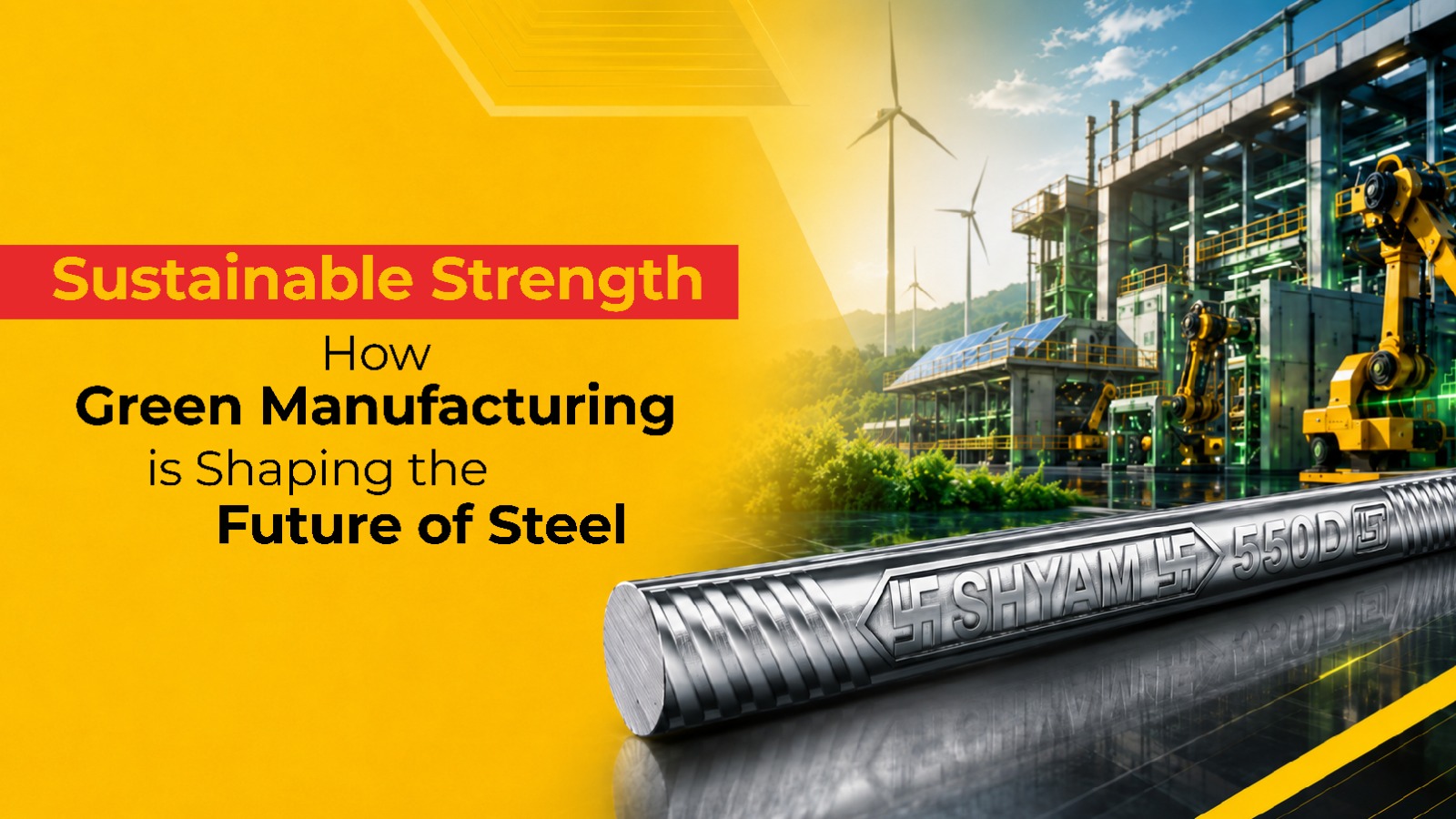
Sustainable Strength: How Green Manufacturing Is Shaping the Future of Steel
Introduction: The Steel Industry at a Crossroads
Every building that rises across India carries a quiet responsibility. Inside the concrete columns, beneath the floors, and threaded through the beams are TMT rebars — the silent skeleton of everything we construct. For decades, the steel that held our structures together was judged on one metric alone: strength. But in 2026, that is no longer enough.
India’s construction sector is at a turning point. With the country’s green building market valued at USD 37.99 billion in FY2024 and projected to reach USD 85 billion by FY2032, the demand for materials that are both structurally superior and environmentally responsible has never been more urgent. Civil engineers and architects across Bihar, Odisha, Jharkhand, and the rest of India are now specifying GreenPro-certified materials not as a premium gesture — but as a baseline professional standard.
At Shyam Steel, we saw this shift coming. Our GreenPro-certified TMT rebars are not a response to industry pressure — they are the result of a long-held belief that strength and sustainability are not opposites. They are the same promise, made at different scales.
What Green Manufacturing Actually Means in Steel
‘Green’ is a word the construction industry has sometimes used loosely. But in steel manufacturing, it has a precise and verifiable meaning — one governed by the CII GreenPro ecolabel, India’s most rigorous eco-certification framework for building products.
GreenPro certification evaluates a product across its full lifecycle: from raw material sourcing and energy consumption in manufacturing, to water use, recyclability, and end-of-life impact. Earning this certification is not a marketing exercise. It requires documented evidence, third-party verification, and ongoing compliance.
Shyam Steel’s GreenPro-certified TMT rebars meet this standard across every dimension. Here is what that means in practice:
1. Energy-Optimised Manufacturing
Traditional steelmaking is energy-intensive. India’s current carbon intensity stands at approximately 2.55 tonnes of CO₂ per tonne of steel produced — one of the highest among major producing nations. Shyam Steel’s manufacturing processes are designed to reduce this footprint at every stage, incorporating best available technologies that deliver measurable emissions reductions without compromising the metallurgical quality of our rebars.
2. Recyclability by Design
Steel is one of the few construction materials that can be recycled indefinitely without any loss of structural properties. Unlike concrete or plastic, which degrade through recycling, steel retains its full mechanical integrity through multiple lifecycles. Every Shyam Steel TMT rebar is engineered with this circularity in mind — making it not just a structural component, but a recoverable material asset at the end of a building’s life.
India’s Extended Producer Responsibility (EPR) regulations will mandate secondary material usage starting at 5% in FY2026-27, rising to 25% by 2030. GreenPro-certified steel from Shyam Steel is directly positioned to help your projects stay ahead of these requirements — without retrofitting your procurement process later.
3. Green Building Credit Compatibility
For projects targeting IGBC, LEED, or GRIHA certification, specifying GreenPro-certified TMT rebars is one of the most efficient credit-earning decisions you can make. Shyam Steel’s rebars directly contribute to multiple material and resource efficiency credits under these frameworks. For engineers managing certification documentation, this means a cleaner, more defensible materials specification — backed by a verifiable ecolabel rather than self-reported claims.
The Numbers That Matter for Engineers in Rest of India
India is currently building at a scale that no other nation matches. Finished steel consumption is projected to grow from 133 million tonnes in FY2022 to 230 million tonnes by 2030-31, with construction and infrastructure as the primary demand driver. In states like Bihar, Odisha, and Jharkhand — where infrastructure development is accelerating fastest — the specification decisions made today will shape structures that stand for 50 to 100 years.
For structural engineers working in flood-prone districts of Bihar or the coastal zones of Odisha, the technical case for high-ductility, GreenPro-certified rebars is particularly strong:
- Fe-500D and Fe-550D grades from Shyam Steel offer enhanced ductility ratios that meet IS 1786:2008 requirements for seismic zones.
- The superior bendability of Shyam Steel TMT rebars reduces on-site fabrication time — a practical advantage in remote project locations where skilled labour availability is limited.
- Consistent mill quality across batches eliminates the variance risk that affects many regional TMT suppliers, reducing the need for costly over-specification.
Why Shyam Steel’s Green Commitment Is Different
The GreenPro certification space in India’s steel industry is growing. More manufacturers are pursuing eco-labels, and that is a positive development. But there is a meaningful difference between a certification earned through process transformation and one added as a compliance measure.
Shyam Steel’s GreenPro credentials are built into our manufacturing identity — not bolted on top of it. As a primary steel manufacturer rooted in West Bengal and East India, we have invested in manufacturing technologies that reduce our environmental footprint as a structural feature of how we operate, not as a response to external pressure.
This distinction matters for the civil engineer or project manager who will stake their professional reputation on the materials they specify. Not all TMT rebars are equal. And not all green certifications carry equal operational substance behind them.
Building the Right Way, Starting Now
India’s green building momentum is irreversible. With 70% of the country’s 2030 urban infrastructure yet to be built, the specification choices happening in project offices across Bihar, Odisha, and the rest of India right now will determine whether that infrastructure is built sustainably — or not.
GreenPro-certified TMT rebars are not a more expensive option reserved for premium projects. They are increasingly the specification standard for any project that plans to remain compliant, competitive, and certifiable in a construction ecosystem that is tightening its environmental requirements every year. At Shyam Steel, sustainable strength is not a product feature. It is what we are made