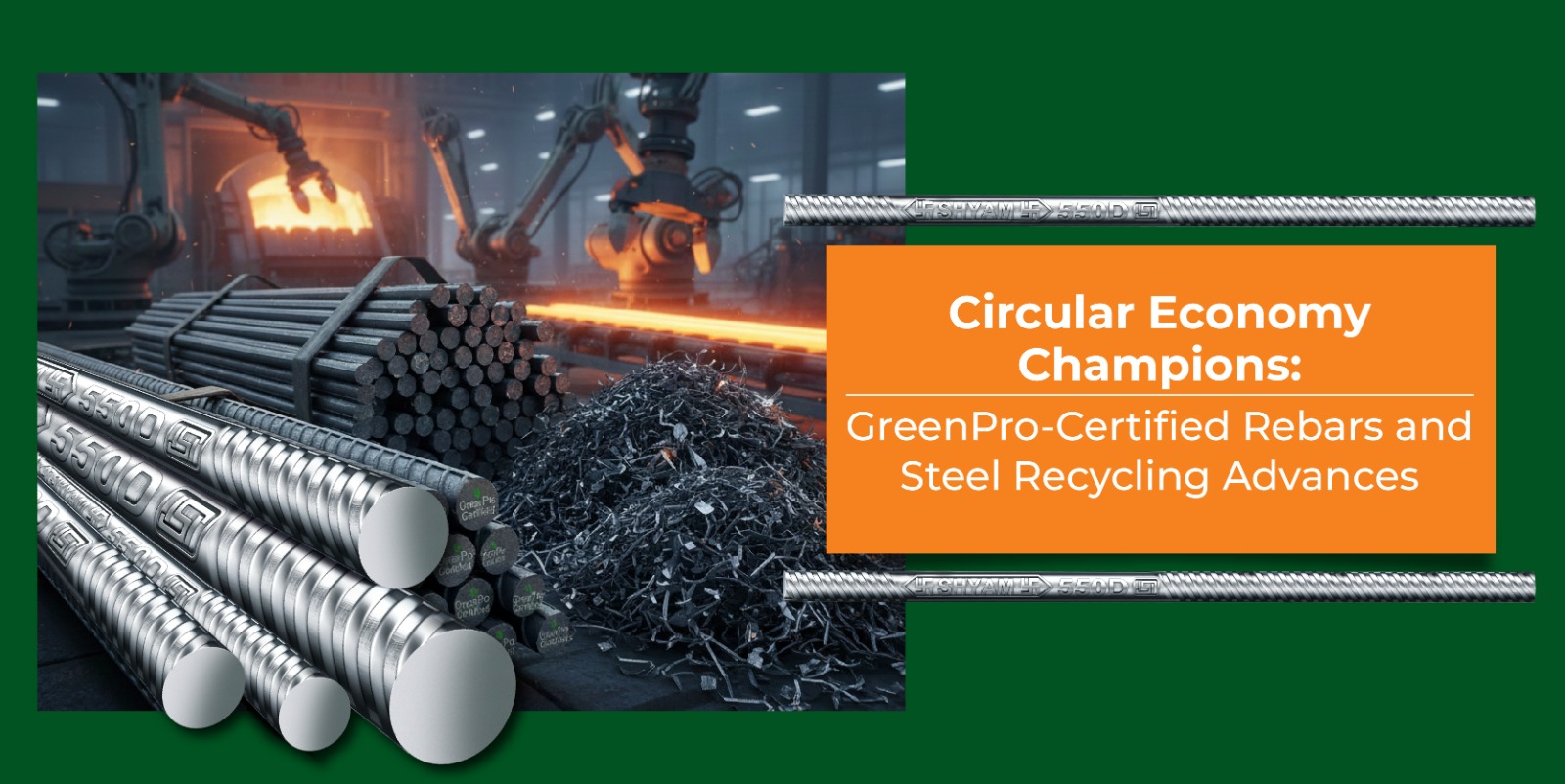
Circular Economy Champions: GreenPro-Certified Rebars and Steel Recycling Advances
Hey, ever thought about what happens to the steel in a building after it’s demolished? Most people assume it ends up in a landfill somewhere, rusting away for centuries. But here’s something that might surprise you – that steel could be holding up a new hospital, school, or your neighbour’s home right now.
Walk into any modern steel recycling facility today, and you’ll witness something remarkable. Mountains of scrap steel from old cars, demolished buildings, and industrial waste being transformed into gleaming new rebars – with zero loss in quality. This isn’t recycling as an afterthought; it’s the foundation of a circular economy that’s reshaping how India builds.
At Shyam Steel, we’ve been part of this transformation for years. Our GreenPro-certified TMT rebars represent more than just a product – they’re proof that construction can be both strong and sustainable. But let’s dig deeper into what circular economy really means for steel, why GreenPro certification matters, and how recycling advances are changing the game for builders across India.
What is a Circular Economy? And Why Does Steel Fit Perfectly?
Let’s break this down simply. The traditional economy works in a straight line: extract raw materials, make products, use them, throw them away. It’s called a linear economy, and it’s incredibly wasteful. A circular economy flips this entirely – products are designed, manufactured, and used in ways that allow materials to cycle back into production indefinitely.
Here’s where steel becomes genuinely exciting. Unlike plastic (which degrades with each recycling cycle) or concrete (which is difficult to recycle at all), steel can be recycled infinitely without losing any of its properties. The TMT rebar in a building demolished today can become part of a bridge built tomorrow – with identical strength, ductility, and performance.
Think about that for a moment. The steel we use in construction isn’t consumed – it’s borrowed. Every ton of steel in circulation represents material that never needs to be mined again. In a world racing to reduce resource extraction and carbon emissions, this makes steel one of the most genuinely sustainable building materials available.
GreenPro Certification: What It Actually Means
You’ve probably seen eco-labels on products before. Some are meaningful; others are marketing fluff. GreenPro certification, issued by the Confederation of Indian Industry (CII), falls firmly in the meaningful category – and understanding why requires looking at what it actually evaluates.
The GreenPro Assessment Framework
GreenPro certification examines a product’s entire lifecycle – not just the finished item, but everything from raw material sourcing to manufacturing processes to end-of-life recyclability. For steel manufacturers, this means scrutiny across multiple dimensions:
- Raw Material Selection: Percentage of recycled content, responsible sourcing of virgin materials, and supply chain transparency
- Energy Consumption: Power usage per ton of steel produced, renewable energy integration, and efficiency improvements
- Emissions Control: Carbon dioxide output, particulate matter, and other air quality impacts
- Water Management: Consumption levels, treatment systems, and discharge quality
- Waste Handling: Slag utilization, scrap management, and zero-waste initiatives
- Product Performance: Durability, recyclability at end of life, and contribution to green building standards
Earning GreenPro certification isn’t a one-time achievement – it requires ongoing compliance and regular audits. Manufacturers must demonstrate continuous improvement, not just static performance. This ensures that certified products represent genuine environmental leadership, not temporary greenwashing.
The Steel Recycling Revolution: How It Actually Works
Steel recycling sounds straightforward – melt old steel, make new steel. But the reality is far more sophisticated, and understanding the process reveals why recycled steel can match or exceed the quality of virgin material.
Stage 1: Collection and Sorting
Steel scrap comes from diverse sources: demolished buildings, end-of-life vehicles, industrial waste, and manufacturing offcuts. Each source has different characteristics, and proper sorting is crucial for quality output. Modern facilities use magnetic separation, spectroscopy, and even AI-powered visual recognition to categorize incoming scrap by type and composition.
Stage 2: Processing and Preparation
Before melting, scrap must be cleaned and sized appropriately. Shredders break large pieces into manageable chunks. Contaminants like paint, plastic coatings, and attached materials are removed. Dense bales are created for efficient furnace charging. This preparation stage significantly impacts the quality and efficiency of the subsequent melting process.
Stage 3: Electric Arc Furnace Melting
Here’s where the transformation happens. Electric Arc Furnaces (EAFs) use powerful electrical currents to melt scrap steel at temperatures exceeding 1,600°C. Unlike traditional blast furnaces that require iron ore and coal, EAFs can operate entirely on scrap steel and electricity – making them ideal for renewable energy integration.
During melting, the steel’s chemistry is carefully adjusted. Unwanted elements are removed through slag formation, while beneficial alloying elements are added to achieve precise specifications. This metallurgical control ensures that recycled steel meets the same standards as primary production.
Stage 4: Continuous Casting and Rolling
Molten steel is cast into billets – solid rebars that become the raw material for TMT rebar production. These billets are then reheated and passed through rolling mills, gradually shaped into the ribbed bars used in construction. The final thermo-mechanical treatment creates the characteristic hard outer layer and ductile core that define quality TMT rebars.
The Numbers That Matter: Environmental Impact of Steel Recycling
Let’s talk facts. The environmental benefits of steel recycling aren’t marginal improvements – they’re transformational:
| Environmental Factor | Savings vs. Virgin Steel Production |
| Energy Consumption | Up to 74% reduction |
| Carbon Emissions | Up to 58% reduction per ton |
| Water Usage | Up to 40% reduction |
| Raw Material Mining | 1.5 tons of iron ore saved per ton recycled |
| Landfill Diversion | 100% of steel is recyclable |
These aren’t theoretical projections – they’re measured outcomes from operating recycling facilities. When you choose steel with high recycled content, you’re directly contributing to these environmental savings.
How Shyam Steel Champions the Circular Economy
At Shyam Steel, circular economy principles aren’t a recent addition – they’re woven into how we operate. Here’s what that looks like in practice:
Maximizing Recycled Content
Our production processes are designed to incorporate high percentages of recycled steel scrap. This isn’t about meeting minimum requirements – it’s about pushing the boundaries of what’s possible while maintaining the quality standards our customers expect. Every batch is optimized to use the maximum feasible recycled content without compromising strength, ductility, or durability.
Energy-Efficient Manufacturing
Our integrated steel plants utilize Electric Arc Furnace technology, enabling efficient scrap melting with lower energy consumption than traditional blast furnace routes. We continuously invest in equipment upgrades and process optimizations that reduce energy use per ton of steel produced. Heat recovery systems capture waste energy and redirect it back into the process.
Waste as Resource
In a truly circular operation, there’s no such thing as waste – only resources waiting to be used. Slag from our furnaces becomes input for cement and road construction. Dust and fines are processed for metal recovery. Water is treated and recirculated. Even the heat from cooling processes is captured and utilized. Our goal is zero waste to landfill – and we’re getting closer every year.
Product Designed for Recyclability
The TMT rebars we produce today will eventually become scrap steel – and we design with that future in mind. Our products are pure steel without coatings or composites that would complicate recycling. When buildings using Shyam Steel are eventually demolished, the rebars inside can flow directly back into production with minimal processing.
Why GreenPro-Certified Steel Matters for Builders
If you’re a builder, contractor, or developer, choosing GreenPro-certified steel isn’t just about environmental responsibility – though that matters too. Here’s why it makes practical business sense:
Green Building Certifications
Projects pursuing IGBC, LEED, or GRIHA certification need to demonstrate sustainable material choices. GreenPro-certified steel provides documented proof of environmental performance, simplifying the certification process and potentially contributing to multiple credit categories.
Government Incentives and Preferences
Public sector projects increasingly prioritize sustainable materials. Having access to certified green steel can be a competitive advantage in tender processes. Some jurisdictions offer tax benefits or preferential treatment for projects using environmentally certified materials.
Brand Differentiation
Homebuyers and commercial tenants increasingly care about sustainability. Buildings constructed with certified green materials command premium positioning in the market. The story of circular economy steel – material that’s been used before and will be used again – resonates with environmentally conscious customers.
Future-Proofing
Environmental regulations are tightening globally and in India. Building with certified sustainable materials today means avoiding potential compliance issues tomorrow. It’s not just about meeting current standards – it’s about anticipating where standards are heading.
The Road Ahead: Innovations Shaping Steel’s Circular Future
The circular economy for steel is evolving rapidly. Here are the advances that will define the next decade:
Hydrogen-Based Steelmaking
The biggest remaining carbon challenge in steel production is the use of coal in blast furnaces. Emerging hydrogen-based processes replace coal with green hydrogen, potentially eliminating direct carbon emissions entirely. Several pilot plants are already operating globally, and commercial-scale facilities are under development.
Advanced Scrap Sorting
AI and machine learning are revolutionizing scrap sorting. Computer vision systems can identify steel types and contamination levels in real-time, enabling more precise input control and higher-quality output. This technology is making it possible to recycle steel streams that were previously too mixed or contaminated to process efficiently.
Digital Material Passports
Imagine if every piece of steel in a building carried a digital record of its composition, origin, and history. Material passport systems are emerging that will make this possible, enabling more efficient recycling by providing precise information about what’s in the material stream. Blockchain technology ensures data integrity across the material’s lifecycle.
Design for Disassembly
Forward-thinking architects are designing buildings that can be taken apart cleanly at end of life, with steel components catalogued for direct reuse without remelting. This represents the ultimate circular economy – material loops that preserve not just the steel itself but the energy invested in fabricating specific shapes and sizes.
India’s Circular Steel Opportunity
India stands at a unique inflection point. Our construction boom is just hitting its stride – the infrastructure and housing we build over the next two decades will define the nation for a century. At the same time, we have the opportunity to build this future sustainably from the start.
The numbers tell the story. India’s steel demand is projected to more than double by 2030. Meeting this demand through virgin production alone would require massive increases in mining, energy consumption, and carbon emissions. But by maximizing recycled content and improving production efficiency, we can grow our steel industry while shrinking its environmental footprint.
This isn’t just about environment – it’s about economics. Recycled steel reduces dependence on imported raw materials. Efficient production lowers costs. Certified green products command market premiums. The circular economy isn’t a sacrifice; it’s a competitive advantage.
Making the Choice: Your Role in the Circular Economy
Every building project involves choices about materials. When you select steel for your next project, you’re not just choosing a structural material – you’re voting for a particular future. Here’s how to make that vote count:
- Ask about recycled content. Reputable manufacturers will share this information. Higher recycled content means lower environmental impact.
- Look for certifications. GreenPro and similar certifications provide third-party verification of environmental claims. Don’t just take marketing at face value.
- Consider the full lifecycle. The cheapest option today might not be the best value when you factor in durability, recyclability, and future regulatory compliance.
- Support circular practices. When demolishing or renovating, ensure steel is properly recovered for recycling rather than landfilled.
- Spread the word. Share what you learn about sustainable steel with colleagues, clients, and partners. Awareness drives demand, and demand drives change.
Building Tomorrow from Today’s Materials
There’s something profound about circular economy thinking. The steel in the building you’re constructing today might have been part of a ship that sailed the seas decades ago, or a bridge that connected communities, or a factory that built the products of an earlier generation. And the steel you use now will continue that journey – becoming part of structures we can’t yet imagine, serving purposes we can’t yet foresee.
At Shyam Steel, we see ourselves as custodians of this material legacy. Our GreenPro-certified TMT rebars represent our commitment to responsible stewardship – taking material that has served its previous purpose, transforming it through clean, efficient processes, and sending it back into the world stronger and ready for new challenges.
The circular economy isn’t a distant ideal – it’s happening now, in facilities across India, in buildings going up today, in the choices made by builders, contractors, and homeowners who understand that strength and sustainability aren’t opposing values. They’re partners in building a better future.
Ready to be part of the circular economy? Looking for GreenPro-certified steel for your next project? Want to understand more about how sustainable steel choices impact your construction goals? We’re here to help – because at Shyam Steel, we believe that every building should be built to last, and built to give back.
━━━━━━━━━━━━━━━━━━━━━━━━━━━━━━━━━━━━━━━━━━
Shyam Steel – Strength That Sustains. Steel That Cycles. Future That Lasts.
GreenPro Certified | www.shyamsteel.com