
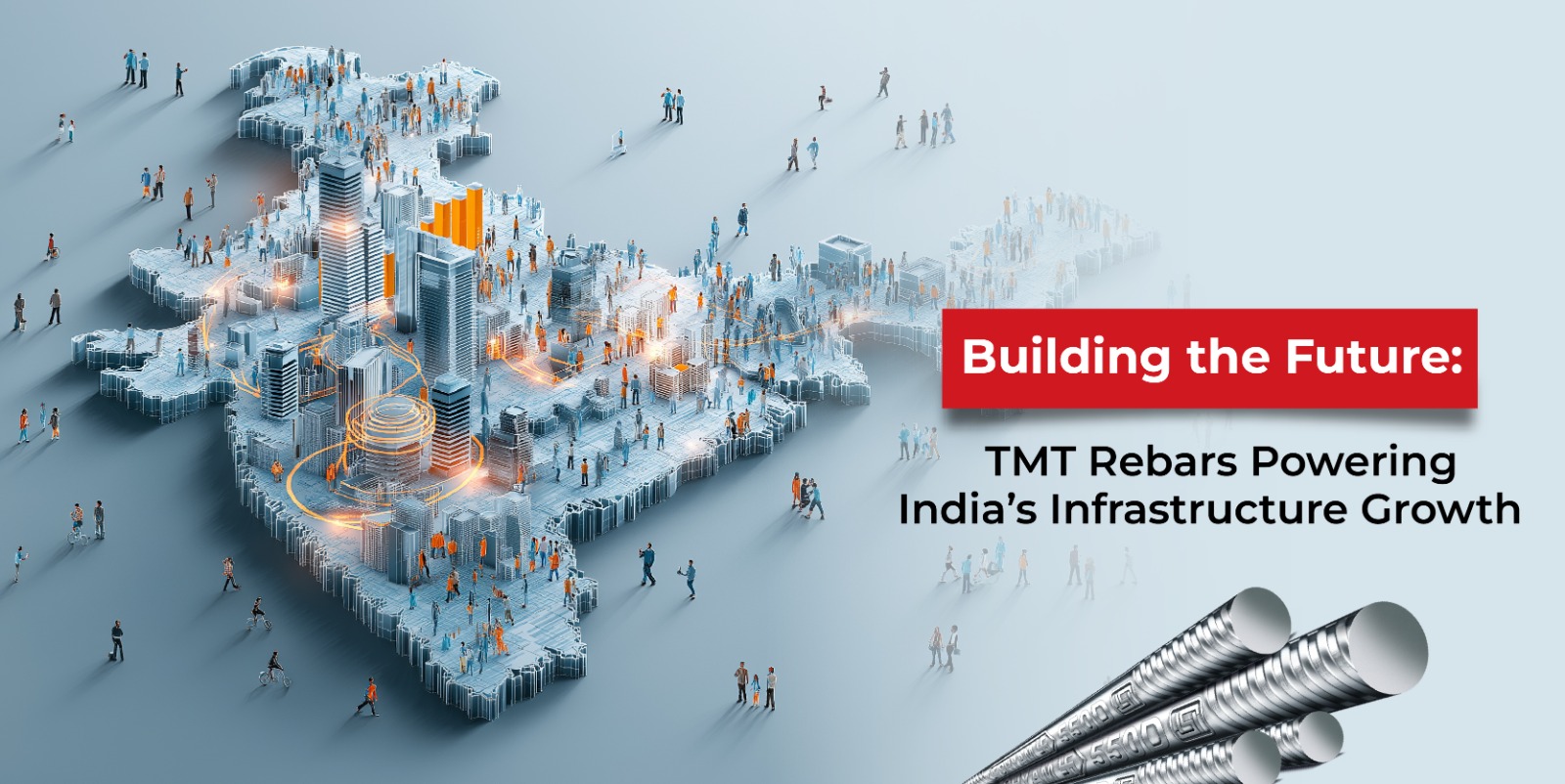
Building the Future: TMT Rebars Powering India’s Infrastructure Growth
Picture this: A six-lane expressway cutting through the floodplains of Bihar. A metro viaduct rising above the congested streets of Patna. An affordable housing block going up in the outskirts of Bhubaneswar under the Pradhan Mantri Awas Yojana. What do all of these have in common? They stand on TMT rebars.
India is building like never before. According to the World Steel Association, Indian steel demand is set to grow at around 9% through 2025 and 2026 – one of the fastest rates anywhere on the planet. Behind every bridge, highway, and housing colony in this surge stands one critical material: high-quality TMT rebars.
But not all rebars are equal. As project sizes grow and safety standards tighten, the difference between ordinary reinforcement steel and certified, high-performance TMT rebars becomes the difference between a structure that merely stands and one that lasts for generations.
In this post, we break down exactly how TMT rebars are shaping India’s infrastructure story – and what you need to know to build smarter, safer, and greener.
1. India’s Infrastructure Boom: The Numbers Behind the Steel Surge
India is in the middle of its most ambitious construction decade. The National Infrastructure Pipeline (NIP) targets an investment of ₹111 lakh crore across roads, railways, ports, energy, and urban development. Bharatmala Pariyojana alone is building 34,800 km of highways – consuming an estimated 15 to 20 million tonnes of steel in the process.
On the housing front, PMAY (Urban) 2.0 is targeting over one crore new homes by 2029, with revised seismic codes mandating higher rebar density in high-risk zones. This isn’t just demand growth – it’s demand for better, stronger, certified rebars.
Here’s a snapshot of where the demand is coming from:
- Roads & Highways: Bharatmala Phase I & II – elevated corridors, underpasses, and flyovers requiring high-tensile Fe 500D and Fe 550D rebars
- Urban Rail: Metro expansion into Tier-2 cities across Bihar, Odisha, and the Northeast
- Affordable Housing: PMAY driving millions of units, especially in states like Bihar and Jharkhand
- Industrial Corridors: PM Gati Shakti linking production zones through warehouses, logistics hubs, and ports
Steel demand from the building and construction segment commanded over 51% of India’s total steel consumption in 2025 – and is projected to grow at a 9.84% CAGR through 2031 (Mordor Intelligence). TMT rebars sit at the heart of this demand.
2. What Makes TMT Rebars the Backbone of Modern Construction
TMT stands for Thermo-Mechanically Treated. The name tells you exactly what happens in production: steel passes through a rolling mill, undergoes rapid water quenching, and then air-cools slowly. The result is a rebar with a hard, tempered martensitic outer rim and a soft, ductile ferrite-pearlite core.
In plain terms? You get steel that is tough enough to take compressive loads and flexible enough not to snap under seismic stress. That combination is what modern construction demands.
Why Fe 500D and Fe 550D Are the Grades to Know
Two grades have emerged as the workhorses of India’s mega-projects: Fe 500D and Fe 550D.
- Fe 500D: Minimum yield strength of 500 MPa. Preferred for heavy RCC structures – flyovers, dams, bridges – where high design load is essential without sacrificing ductility.
- Fe 550D: Minimum yield strength of 550 MPa. The go-to grade for critical infrastructure, seismic zones, and Indian Railways-approved projects. Higher tensile strength means less steel used, directly reducing project costs.
Both grades fully comply with Indian Railways (RDSO) specifications and IS 13920:2016 (Amendment 2) – the seismic safety standard for reinforced concrete structures. Meeting this standard requires a TS/YS ratio between 1.15 and 1.25 and minimum elongation of 14.5%. It’s not a box-ticking exercise. It’s the minimum bar to build safely in earthquake-prone regions like the Northeast, Bihar, and Odisha.
3. Why Seismic Safety Matters More Than Ever in Rest of India Markets
Construction professionals working across Bihar, Jharkhand, Odisha, Assam, and the Northeast operate in some of India’s most seismically active zones. The Bureau of Indian Standards classifies significant portions of these states under Seismic Zones III, IV, and V.
In these regions, a rebar that merely meets minimum BIS standards isn’t enough. You need rebars that perform under dynamic loading – the kind that earthquakes, floods, and ground movement impose over a structure’s lifecycle.
What Seismic Compliance Actually Requires
- Proof Stress (YS): Minimum 500 MPa (Fe 500D) / 550 MPa (Fe 550D)
- TS/YS Ratio: Must fall between 1.15 and 1.25 – too high or too low, and the rebar fails the seismic test
- Elongation: Minimum 14.5% – this is the flex the rebar needs to absorb seismic energy instead of fracturing
- Maximum YS: Capped at 1.2× the minimum – preventing steel that is so hard it becomes brittle
Project managers and structural engineers in these regions should treat seismic compliance not as an optional certification, but as a non-negotiable procurement criterion.
4. Corrosion Resistance: The Silent Make-or-Break Factor
Here is a problem that often surfaces only after construction is complete: premature rebar corrosion. In coastal areas, flood-prone plains, and high-humidity zones – which describe much of Bihar, Odisha, and coastal Odisha’s construction landscape – standard rebars can begin to rust within years of installation.
Corrosion doesn’t just weaken the steel. It causes the rebar to expand, cracking the concrete around it from the inside. This process, called spalling, silently destroys structural integrity long before a building’s design life is over.
What Protects TMT Rebars Against Corrosion
The thermo-mechanical treatment process creates a thick, uniform tempered martensitic rim on the outer surface of the rebar. This rim is inherently more corrosion-resistant than the surface of conventionally rolled steel. Combined with low carbon equivalent values (which reduce the risk of hydrogen-induced cracking), high-grade TMT rebars significantly outperform ordinary reinforcement steel in aggressive environments.
For projects in coastal Odisha or the flood-prone districts of Bihar, specifying Fe 500D or Fe 550D TMT rebars with documented corrosion-resistance test data isn’t an upgrade – it’s standard engineering practice.
5. Green Construction Is No Longer Optional – It’s a Procurement Criterion
India’s construction industry is undergoing a green transformation. The Smart Cities Mission, green building codes under GRIHA and IGBC, and public-sector procurement mandates are all pushing builders, contractors, and developers toward certified sustainable materials.
GreenPro certification – issued by the CII–Green Products and Services Council – has emerged as the benchmark for environmentally responsible construction materials in India. Products carrying GreenPro certification are evaluated across the full material lifecycle: raw material extraction, manufacturing energy use, water consumption, recyclability, and end-of-life impact.
Why GreenPro Certification Matters for Your Projects
- IGBC, LEED, and GRIHA points: GreenPro-certified rebars directly contribute to green building rating credits, simplifying your certification journey
- Public-sector eligibility: Government procurement for infrastructure increasingly prioritises certified sustainable materials – a trend that will only intensify as India moves toward net-zero commitments
- Brand value: Developers and EPC contractors can demonstrate sustainability commitments to institutional clients, lenders, and ESG-conscious investors
- Circular economy advantage: Steel is one of the few construction materials that can be recycled indefinitely without loss of properties – reducing embodied carbon across project lifecycles
6. The Practical Guide to Specifying TMT Rebars for Major Projects
Procurement decisions on rebar can make or break both project timelines and safety outcomes. Here is a structured checklist that construction professionals across Bihar, Odisha, Jharkhand, and the Northeast should use when specifying TMT rebars for infrastructure projects:
Step 1 – Match the Grade to the Application
- Columns, deep foundations, seismic zones → Fe 550D
- Slabs, beams, standard RCC → Fe 500D
- Light residential (G+2) → Fe 415 (minimum)
Step 2 – Check BIS Certification and Mill Test Certificates
Every rebar consignment should come with a Mill Test Certificate (MTC) that shows yield strength, tensile strength, elongation, and bend test results from the actual production batch. Do not accept MTCs from a different heat number than the delivered consignment.
Step 3 – Verify Seismic Compliance for High-Risk Zones
For projects in Seismic Zones III–V, confirm that the rebars meet IS 13920:2016 (Amendment 2) and RDSO specifications. Ask for documented TS/YS ratio and elongation data from an accredited test lab.
Step 4 – Demand Sustainability Documentation
If your project targets IGBC, LEED, or GRIHA certification, request the GreenPro certification number and the corresponding credit documentation. GreenPro cert numbers can be verified directly through the CII–Green Products and Services Council registry.
Step 5 – Assess the Supply Chain for Your Region
For projects in Bihar, Jharkhand, Odisha, and the Northeast, assess the manufacturer’s dealer network and logistics capability in your district. Regional supply consistency matters as much as product quality – a project stalled by rebar stockouts causes real delays and cost overruns.
7. The Market Outlook: What’s Driving TMT Rebar Demand Through 2030
The medium-term demand picture for TMT rebars in India is unambiguously strong. India’s finished steel consumption is projected to grow from 133 MT in FY22 to 230 MT by 2030–31, with the building and construction segment leading the charge.
The TMT rebar market’s current size is estimated between ₹1,30,000 crore and ₹1,40,000 crore, while the broader construction ecosystem that depends on TMT rebars is worth over ₹14 lakh crore (First Construction Council).
Key demand drivers that are shaping the next five years:
- PM Gati Shakti: Seven-engine infrastructure push covering roads, railways, airports, ports, waterways, mass transit, and logistics
- Smart Cities Mission: 100 cities under active development, each requiring high-spec structural steel for public infrastructure
- Dedicated Freight Corridors (Phase 2): Elevated structures and bridges requiring high-tensile rebars at scale
- Metro Rail Expansion: Tier-2 cities in Bihar, Odisha, and the Northeast are the next frontier for urban transit
- PLI for Specialty Steel: ₹40,000 crore in investments targeting 25 million tonnes of additional capacity by 2026–27
Regional gaps in supply and logistics – particularly pronounced in Bihar, Odisha, Jharkhand, and the Northeast – continue to create both challenges and opportunities for regional manufacturers and established players with strong on-ground distribution networks.
Building the Future, One Rebar at a Time
India’s infrastructure story is being written in steel. Every highway on-ramp in Patna, every metro pillar in Bhubaneswar, every PMAY home rising above the floodplain – they all start with a rebar specification.
As a construction professional, your material choices have consequences that outlast any project timeline. Choosing certified, high-performance TMT rebars – specified to the right grade, validated by mill test data, and backed by sustainability credentials – isn’t just good engineering practice. It’s how you ensure the structures you build will still be standing, safely, decades from now.
The demand is real. The standards are clear. The infrastructure is being built right now. The only question is: are the rebars you’re specifying ready for the scale of what India is building?
At Shyam Steel, we engineer TMT rebars that meet this moment – GreenPro-certified, seismic-compliant, and field-tested across India’s most demanding infrastructure projects.